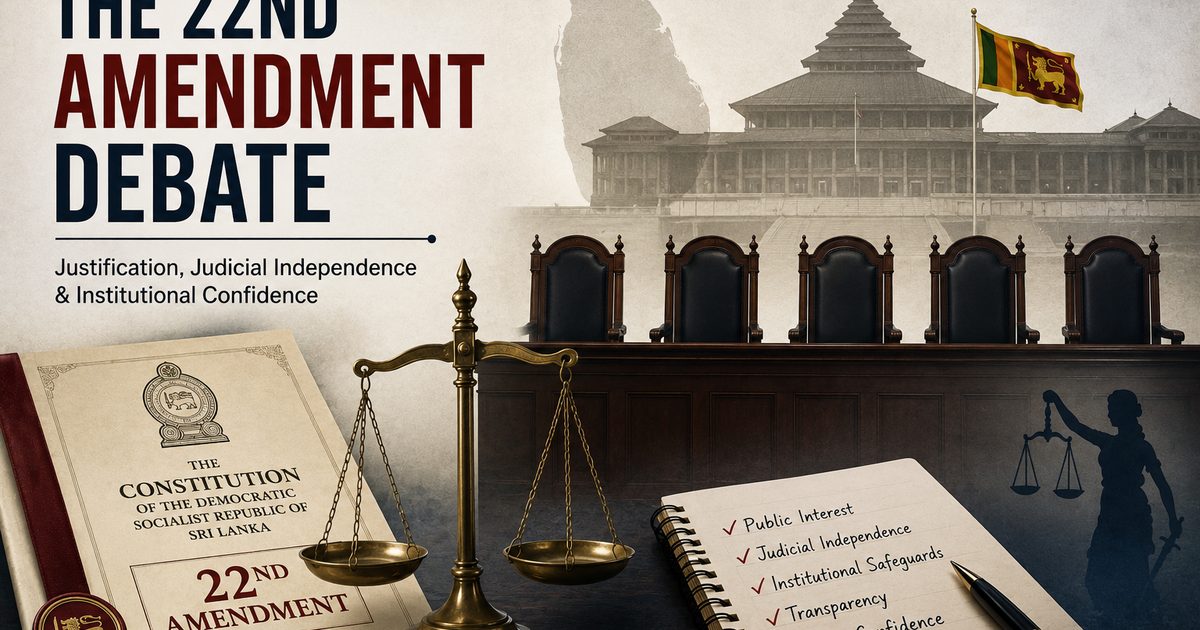
A constitutional debate that has moved beyond the retirement age of judges
The controversy surrounding Sri Lanka's proposed 22nd Amendment to the Constitution is no longer confined to the relatively narrow question of whether the retirement age of judges of the superior courts should be increased.
It has developed into a much broader debate about judicial independence, conflicts of interest, institutional safeguards and, perhaps most importantly, public confidence in the constitutional process.
The Government may be able to offer policy reasons for changing the retirement age of judges. Increasing judicial retirement ages is not, by itself, inherently incompatible with judicial independence. Different jurisdictions adopt different retirement ages, and a government may legitimately argue that experienced judges should remain in service for longer.
The more difficult question is different:
Why should such a change apply in circumstances where it directly affects the tenure of judges currently holding office, and have subsequent decisions by the Government and the judiciary strengthened or weakened the credibility of the explanations offered for doing so?
That is where the present controversy deserves careful examination.
What does the proposed amendment do?
The proposed 22nd Amendment was gazetted on 7 August 2026.
It would increase the mandatory retirement age of Supreme Court judges from 65 to 67 and that of Court of Appeal judges from 63 to 65.
It also reportedly introduces a specific tenure provision for the Chief Justice, under which retirement would occur upon reaching 67 years of age or completing six years from appointment as Chief Justice, whichever occurs first.
The Bill also proposes increasing the maximum number of Court of Appeal judges.
By 1 September 2026, reports stated that 67 petitions challenging the proposed 22nd Amendment were before the Supreme Court.
The central controversy is therefore not simply whether 65 or 67 is the better retirement age.
It concerns the institutional consequences of changing the rules governing judicial tenure while those rules apply to identifiable sitting judges.
The Government's possible policy justification
There is a legitimate policy argument for reviewing judicial retirement ages.
Life expectancy, professional longevity, the value of judicial experience and international comparisons may all justify reconsidering retirement ages established many years ago.
If that is the Government's position, it deserves consideration on its merits.
The National Peace Council, for example, has cited retention of experienced judges, case backlog, continuity and demographic change among considerations that could support retirement-age reform. That statement is relevant as an example of a substantive argument in favour of reform; it should not be treated as proof of the Government's motive.
But a sound general policy and the method by which that policy is implemented are two different questions.
A government could, for example, establish a new retirement age prospectively, applying it to judges appointed after a specified date.
Alternatively, Parliament could choose to apply the new age to sitting judges.
The latter approach immediately creates a more difficult constitutional and institutional question because legislation then changes the duration of office of presently identifiable members of the judiciary.
That does not automatically make the proposal unconstitutional.
But it does require a particularly convincing public-interest justification and particularly careful institutional safeguards.
Why the Chief Justice became central to the controversy
The proposed amendment has generated particular attention because the current Chief Justice is among those whose tenure could potentially be affected by the proposed constitutional change.
This created an obvious institutional difficulty when petitions challenging the amendment reached the Supreme Court.
The Chief Justice heads the five-member bench hearing the constitutional challenges.
The other members are Justices Achala Wengappuli, Arjuna Obeyesekere, Sampath B. Abayakoon and K.M. Gihan H. Kulatunga.
Several petitioners consequently raised objections concerning the composition of the Court.
President's Counsel M.A. Sumanthiran, appearing in the proceedings, requested that the matter be considered by the Full Court. Other senior counsel supported the request.
The argument was not merely that five judges were legally incapable of considering the Bill.
It concerned the appearance of institutional independence where judges were being asked to adjudicate upon legislation capable of affecting judicial tenure.
The distinction between legal authority and institutional prudence
This is perhaps the most important distinction in the entire controversy.
Article 132(3) of the Constitution gives the Chief Justice authority, in the circumstances contemplated by that provision, concerning the constitution of a bench of five or more judges.
The Solicitor General relied upon that constitutional authority in opposing the request for a Full Court.
The Supreme Court ultimately rejected the request and continued with the five-member bench.
Therefore, criticism should not inaccurately suggest that the Chief Justice necessarily lacked constitutional authority to constitute the bench.
But having legal authority to make a decision and whether exercising that authority in a particular way best protects public confidence are not necessarily the same question.
Constitutional institutions frequently operate in areas where legality establishes the minimum boundary, while institutional convention, restraint and avoidance of apparent conflicts provide additional safeguards.
That distinction deserves serious public discussion.
Bench composition adds another dimension to the Government's justification
The composition of the five-member bench has introduced another dimension to the debate.
The Government and supporters of the proposed reform can legitimately argue that increasing the retirement age allows the judiciary to retain experienced judges for longer. Experience and institutional continuity are rational considerations when determining a judicial retirement age.
However, the composition of the bench selected to determine the constitutional challenges has itself prompted questions about that justification.
Apart from the Chief Justice, the bench comprises Justices Achala Wengappuli, Arjuna Obeyesekere, Sampath B. Abayakoon and K.M. Gihan H. Kulatunga.
Several judges with longer service in the Supreme Court were not included in the five-member bench. Publicly available appointment records indicate that these include Justice Yasantha Kodagoda and Justices A.H.M.D. Nawaz and A.L. Shiran Gooneratne. Justice Janak de Silva also entered the Supreme Court in December 2020, while Justice K.M. Gihan H. Kulatunga was elevated to the Supreme Court in December 2025.
This does not, by itself, establish anything improper about the selection of the bench. Seniority is not necessarily a legal requirement for constitution of every Supreme Court bench, and there may be legitimate judicial or administrative considerations behind its composition.
Nevertheless, it creates a legitimate question in the context of the Government's own policy justification.
If retaining the experience of senior judges is an important reason for extending judicial tenure, critics may reasonably ask why several judges with substantially longer Supreme Court service were not selected for one of the most consequential constitutional proceedings concerning that very proposal.
The point is not that the most senior judges were legally required to hear the case.
Rather, the apparent contrast between the policy argument, retaining judicial experience, and the composition of the bench makes that justification more difficult to present as a complete answer to the concerns surrounding the amendment.
It is therefore another reason why greater transparency surrounding both the proposed constitutional change and the institutional processes associated with it would strengthen public confidence.
The Government faces a similar problem
The same distinction applies to the Government.
It is possible for the Government genuinely to believe that extending judicial retirement ages is desirable public policy.
But once the proposed amendment has identifiable consequences for sitting judges, the Government must anticipate concerns about independence and personal benefit.
The burden of institutional explanation therefore becomes greater.
Why now?
Why these particular ages?
What objective evidence supports them?
Why should the change apply to presently serving judges rather than future appointments?
What alternatives were considered?
What safeguards were considered to prevent the reform from being perceived as benefiting particular office-holders?
These are not partisan questions.
They are precisely the questions that should accompany any constitutional reform affecting the tenure of judges.
The danger of subsequent conduct
This is where the Government's difficulty may now be greatest.
A controversial constitutional amendment can initially be defended through policy arguments.
But subsequent conduct can either reinforce those arguments or make them progressively less persuasive.
If the Government wishes the public to understand the amendment as a neutral institutional reform, every subsequent step should reinforce that neutrality.
If, instead, subsequent events repeatedly create the appearance that identifiable individuals may benefit, that unusual institutional arrangements are necessary, or that safeguards capable of distancing those individuals from the process have not been adopted, then the original policy justification inevitably becomes harder to sustain in the court of public opinion.
That does not prove an improper motive.
But it changes the credibility environment in which the Government's explanation is assessed.
The same standard must apply to critics
Critics of the amendment also have responsibilities.
Concerns about judicial independence do not justify personal attacks against judges.
Disagreement with the constitution of a bench does not establish corruption, conspiracy or political collaboration.
Nor should the political opposition transform a serious institutional question into allegations unsupported by evidence.
Doing so would itself damage judicial independence.
The appropriate criticism is therefore institutional rather than personal:
Could the process have been designed in a way that created greater distance between potential beneficiaries of the constitutional amendment and decisions concerning judicial consideration of that amendment?
That is a legitimate democratic question.
Appearance matters in judicial independence
Judicial independence depends not only upon whether judges actually act independently.
Public confidence also depends upon institutional arrangements that minimise reasonable perceptions of conflicts of interest.
This is why constitutional democracies develop doctrines concerning recusal, institutional independence, security of tenure and separation of powers.
The purpose is not necessarily to suggest that an office-holder would act improperly.
It is to construct institutions in which the public does not have to rely solely upon the personal integrity of individual office-holders.
Good constitutional design reduces both actual conflicts and reasonable appearances of conflict.
The larger lesson for Sri Lanka
The 22nd Amendment controversy therefore presents Sri Lanka with a question larger than the retirement age of judges.
A constitutional democracy cannot operate sustainably on the principle:
"The Constitution permits us to do this."
The better question is:
"Does exercising that constitutional power in this particular manner strengthen the institution and public confidence in it?"
Government, Parliament and the judiciary each possess substantial constitutional powers.
The strength of democratic institutions often depends upon how responsibly those powers are exercised, particularly where an institution is dealing with a matter capable of affecting itself.
Conclusion
It would be premature to conclude that the controversy surrounding the 22nd Amendment proves improper motives on the part of either the Government or members of the judiciary.
Such a conclusion requires evidence.
But it is equally difficult to dismiss the institutional concerns that have emerged.
The Government must explain why the amendment should affect sitting judges rather than operate prospectively.
Critics must make their case without turning constitutional disagreement into unsupported personal accusations.
And the judiciary faces the difficult responsibility of exercising powers concerning bench composition in circumstances where public confidence requires not merely legal correctness, but visible institutional independence.
The central lesson is therefore broader than the fate of the 22nd Amendment itself:
When constitutional changes can affect the tenure of those who exercise judicial power, legality alone is not enough. The process must also be capable of commanding public confidence.
That principle protects neither Government nor Opposition, neither a particular Chief Justice nor a particular petitioner.
It protects the institution.
Sources and further reading
- Centre for Policy Alternatives and Dr. Paikiasothy Saravanamuttu v. The Attorney General, SC SD 50/2026
- NewsFirst: 22A Gazetted, Supreme Court Judges to Serve Until 67
- The Morning: SC takes up 22A challenges
- The Island: SC rejects petitioners' request for full bench
- Newswire: Supreme Court rejects full bench request for 22A petitions
- National Peace Council: 22nd Amendment should strengthen judicial independence and continuity
- Ada Derana: Gihan Kulatunga sworn in as Supreme Court Judge
These sources are used according to source hierarchy: official legal materials and filed petition material for legal claims; reliable reporting for oral proceedings; and organisational statements only for the arguments made by those organisations.