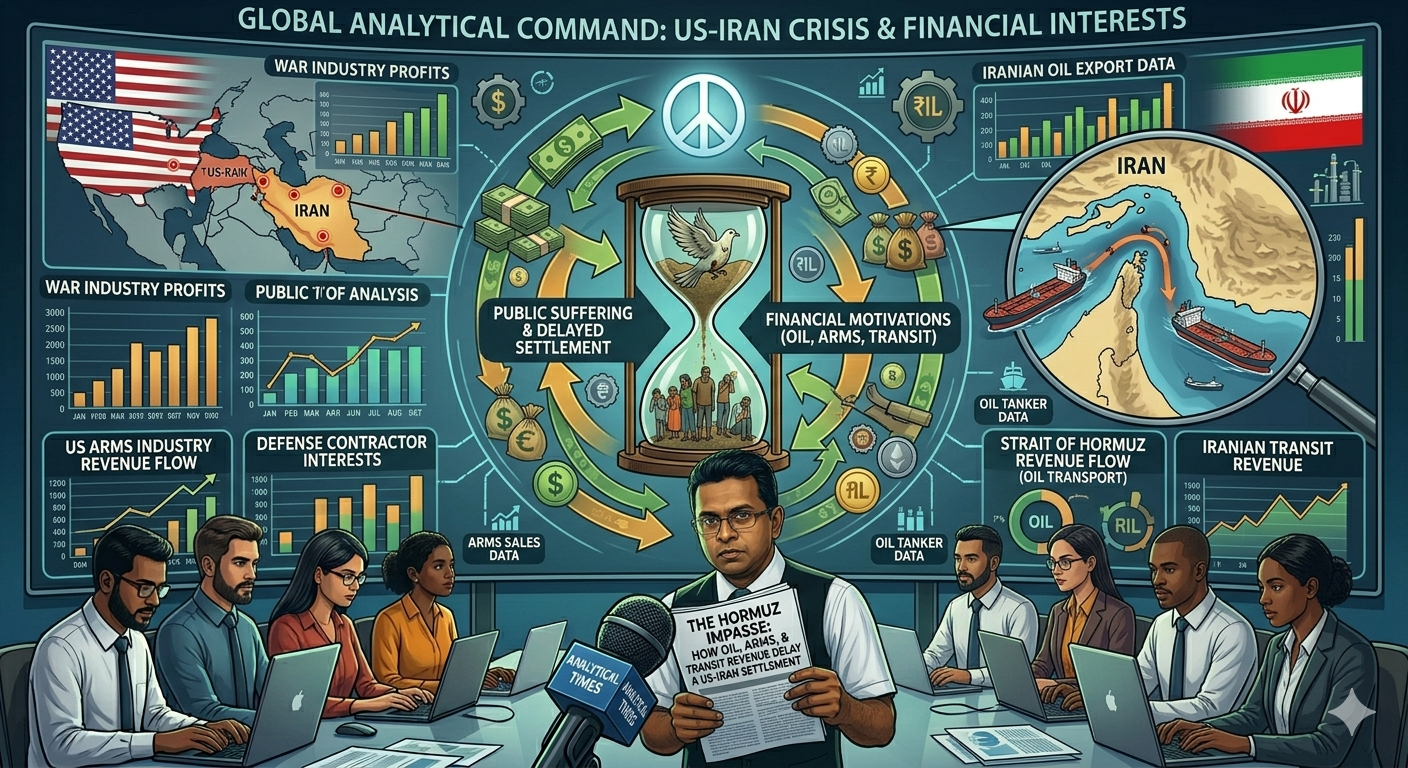
Every barrel of oil that passes through the Strait of Hormuz carries more than energy—it carries the hidden cost of geopolitical tension.
In times of conflict, governments speak the language of security. They invoke threats, deterrence, and stability. The ongoing confrontation between the United States and Iran is no exception. Official narratives emphasize nuclear risk, regional aggression, and the need to maintain order in a volatile Middle East.
Yet beneath these familiar justifications lies a harder, less comfortable truth: modern conflicts are rarely detached from economics. In this case, the global energy system—and the immense financial interests tied to it—forms an inseparable part of the story.
At the center of this geopolitical drama is that narrow maritime corridor—the Strait of Hormuz—through which roughly a fifth of the world’s oil supply flows. Any disruption, or even the credible threat of disruption, sends immediate shockwaves through global markets. Prices surge, insurance premiums rise, and the cost of stability is redistributed across the world.
It is here that strategy and economics converge most visibly.
For the United States and its allies, maintaining open access through the strait is framed as a matter of global security. For Iran, the same geography represents leverage—a rare and powerful tool in an otherwise asymmetric confrontation. The ability to disrupt, delay, or simply threaten shipping transforms geography into influence.
But beyond disruption lies a subtler and often overlooked dimension: control over passage can also create opportunities for economic extraction.
In conflict-prone waterways, “security” often evolves into monetization. Shipping through high-risk zones comes with escalating costs—war-risk insurance, private security, naval escorts, rerouting expenses, and delays. In more opaque settings, there can also be informal payments, facilitation arrangements, or coercive pressures that effectively function as tolls for safe passage. While such mechanisms are not always officially acknowledged, the pattern is well established: risk becomes a commodity, and access acquires a price.
The Strait of Hormuz is no exception. As tensions rise, the cumulative financial burden of moving oil through the region increases—costs that are ultimately passed on to the global economy. In this environment, instability itself generates economic flows. The longer uncertainty persists, the more entrenched these costs become.
This does not mean that any single actor fully controls or directly profits from these dynamics. But it does highlight an uncomfortable reality: conflict conditions can produce revenue streams linked to risk, protection, and access, creating subtle incentives that may discourage rapid de-escalation.
The economic dimension extends beyond the strait. Elevated oil prices benefit producers outside the conflict zone. Defense industries expand as military demand increases. Certain sectors within major economies gain indirectly from sustained geopolitical tension. These are not conspiratorial claims—they are structural features of how global markets respond to instability.
None of this suggests that the conflict is driven solely by financial interests. Such a view would be overly simplistic. Security concerns remain real and significant. The question of nuclear capability continues to shape strategic calculations. Regional power struggles, ideological rivalry, and long-standing mistrust all play defining roles. For Washington, preventing a hostile power from dominating the Gulf is a strategic priority. For Tehran, resisting external pressure is tied to sovereignty and survival.
But these motivations do not exist in isolation. They operate within a system where economic incentives can reinforce, prolong, and intensify conflict dynamics.
Recognizing these economic undercurrents is essential—not to assign blame, but to understand why such conflicts persist despite their global cost.
For countries far removed from the Gulf—such as Sri Lanka—the consequences are immediate and tangible. Fuel prices rise, inflation accelerates, and fragile economies face renewed strain. What appears as a distant geopolitical confrontation becomes a daily economic reality.
Understanding the US–Iran crisis, therefore, requires moving beyond single-cause explanations. It is neither purely about security nor purely about profit. It is about the intersection of both—where strategic imperatives meet economic opportunity, and where control over resources, routes, and risk becomes a form of power in itself.
In today’s world, the most profitable part of a war may not be victory—but its continuation.